tattoos
Showing posts with label 1949. Show all posts

Monday, June 27, 2011

Thank You and 1949 Evening Gowns

Thank you a thousand times for the huge outpouring of support after my blog post last Monday.  As your comments and emails poured in during the day and throughout the rest of the week, it became crystal clear that my time spent here is worth every minute.  I appreciate every one of you and am so glad that you enjoy my work.  I want you to know that I approved and posted every comment that came in, including a couple of less-than-positive remarks from anonymous posters.  In response to a few suggestions, I have removed the word verification from comments and will be watermarking the photos in a less conspicuous way.  And now, back to work!

I wish I could tell you where Louise Dahl-Wolfe took these beautiful photos in 1949.  The background of the antique silvered mirror wall provides a perfect setting for three luscious party dresses that are perfect for summer.

Left:  Red and white polka dotted cotton organdy fashions a strapless pouf of a dress by Fred Perlberg.  Prarie points accent the edge of the bodice.  Sold for $29.95 in 1949 (about $284 in today's dollar.)
Right:  More organdy, this time in white printed with bouquets of roses.  The gown is by Ceil Chapman and has a ruched bodice with a shoulder wrap that extends from one side.  Sold for $70 in 1949 (about $665 in today's dollar.)

David Klein designed this dress to look like a flower.  White taffeta forms petals over netting in the skirt.  Sold for $35 in 1949 (about $332 in today's dollar.)

Thursday, April 14, 2011

I'll Have One of Each Please!

 Don't these shoes look great?  And comfortable too!  Town & Country ran this two page ad to introduce their new line of jewel-toned shoes and bags for spring of 1949.  They were made of Maracain, which was a trademark of Allied Kid Company.  Maracain was "unfinished and partly finished leather made from kid, goat, calf, or cowhide."

At left, the Basquette wedge sling back came in turquoise, yellow, red or green.  On the right, the Basquette low heel shoe came in turquoise only.

At left, the Allegro sandal came in yellow, turquoise, green, red, and white.  There's the Basquette wedge again at the right.  All of the shoe styles sold for $8.95 in 1949 (about $83.00 in today's dollar.)  And here's the kicker:  they were all available in sizes 4 to 10 and widths AAA to B.  I wish today's shoes were available in all those sizes.

The matching purse came in all the colors and sold for $10.75 in 1949 (about $100.00 in today's dollar.)

Since I can't choose, I'll have one pair of each please, in all the colors.....and the matching bags would be nice too.  Aren't they great?

Monday, February 28, 2011

The Little Brown Dress

Christian Dior, 1949Christian Dior New York ribbed silk dress with a large bow draped across the bodice.

It is said that every woman should have a little black dress in her wardrobe. But if you subscribe to the "seasonal" skin tone theory, the only people who can truly wear black near their face well are those described as "winter". The rest of us should choose something less harsh like gray, navy, or brown. Granted, I wear black a lot, but rarely on top because I am a "spring". Black near my face tends to accentuate the rings under my eyes and makes me look tired. I do like to wear brown, though. It just works for me. What about you? Do you wear brown as a neutral in your wardrobe?

In the spring of 1949, brown was a popular color of choice for many fashion designers (especially M. Dior), as evidenced in these photos.

Omar Kaim, 1949Omar Kaim for Ben Reig silk organza and satin evening gown with a large bow at the side.

Christian Dior, 1949, suitChristian Dior Couture brown wool suit.

Jo Copeland, 1949Jo Copeland brown tulle over taffeta dress with low decollete.

Christian Dior, 1949Christian Dior Couture silk dress with fly-away skirt panel at the back.

Tuesday, January 25, 2011

Omar Kiam for Ben Reig, 1949

Could you just die? This stunning ensemble was designed by Omar Kiam for Ben Reig in the spring of 1949. The floral fabric is an Onondaga silk styled by Philip A. Vogelman. The little capelet jacket slips on over a sheer white blouse with pearl buttons. The pearls are echoed in a triple strand choker at the neck. Can you see the ingenious draping of the skirt? Click on the picture for a larger view if you like.

But what about that chair she's standing in front of? Can anyone tell me about it?

Sunday, December 19, 2010

Weekend Eye Candy - Christian Dior, 1949

Staying warm in a Christian Dior red wool coat with black fox fur at the sleeves, 1949.

Tuesday, October 26, 2010

Filene's French Shops

If you live in Boston, you remember Filene's, the city's venerable old department store in Downtown Crossing. Founded in 1881 by William Filene, the store was best known for the famous Filene's Basement where surplus and closeout bargains were housed. But if you left the chaos and hubbub of the basement and made your way upstairs to the Third Floor, you would find the elegant French Shops. Started in the 1920s and lasting into at least the 1960s, this is where Filene's offered exclusive and expensive clothing from the best known designers of the day. While it may have started out offering only French clothing, by the 1940s the French Shops carried garments by the elite of American designers as well. Below are images from a two page advertisement in Harper's Bazaar from 1949.

"Filene's French Shops present Adrian's Baroque Memories, a commanding dinner costume with dramatic long-paneled stole."

"Filene's French Shops present Nettie Rosenstein's Petal Chemise, billowing lace over a sheath of pure silk taffeta."

Adrian and Nettie Rosenstein? Where's that time machine when I need it?

Wednesday, September 29, 2010

Vacation Time!

Amelia Earhart luggage 1949Dear friends, I am headed off to the West Coast to visit family for a few days. The website will be closed, and there will be no shipping until October 12. But the blog will still be active, with fresh new posts every day while I am away.

While I have no desire to take 6 suitcases with me, I do wish I had this sweet little jacket from 1949. The original was designed by Jacques Fath and was copied in the US by Jaunty Junior in suede. Sold in 1949 for $55 (about $508 in today's dollar).

Thursday, August 26, 2010

That Touch of Mink

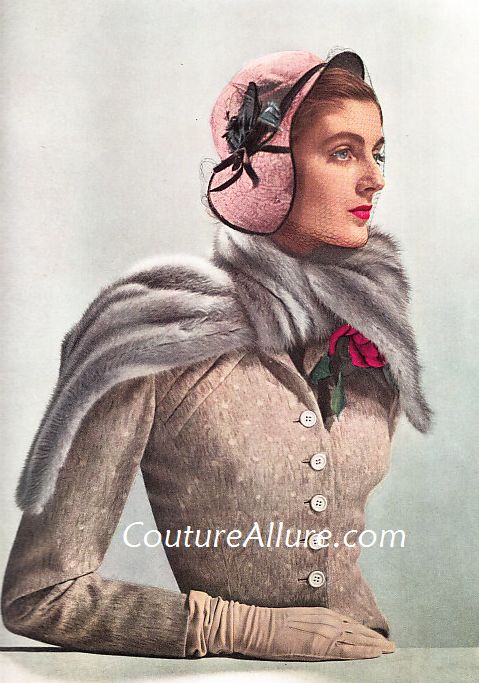
I love these ideas from 1949 for wearing just a touch of mink. At a time when most women wore stoles of the entire mink pelt, including the heads, feet, and tails, these fur scarves are a refreshing change of pace.

If you have a damaged fur coat or stole and don't know what to do with it, making a scarf like this can preserve at least some of the pelts. If you prefer not to wear real fur, there are lots of high quality faux fur fabrics on the market.

Even the narrowest length of fur can be tied in a jaunty bow at the neck. Fun!

Wednesday, July 28, 2010

Vintage Suits - 1949

I don't think you can find anything more unique and more sexy than a vintage suit from the late 1940s through the 1950s. Suits from this era are fitted to the body, exquisitely tailored, and they always have unique design details. They were made with great attention to fine construction. You'll usually find bound buttonholes, high quality fabrics, interfacings and linings, and wide seam allowances to allow for individual alterations.

Just look at the Paul Parnes suit from 1949 shown above. It closes with buckles instead of buttons, the white lapel and cuffs are probably removable for a different look, and the pockets and peplum are top-stitched. This suit sold for $125.00 in 1949 (about $1155.oo in today's dollar).

The fact is, a suit from the 1940s or 50s will always be of higher quality than anything you can buy today, unless you're shopping couture. That makes a vintage suit a fabulous bargain as well.

The suit above, by Philip Mangone for Bonwit Teller has bands of ruching at the lapels, cuffs, and at the hem edges of the jacket and skirt. Mangone was one of the premier suit makers at the time, and his suits are highly sought after today.

In the 1940s and 50s, most women had at least one suit in their closet to wear to meetings, to dinner, to go shopping in the city, for travel, or to wear to appointments with professionals such as doctors, attorneys, or teachers. Because suits were so well made, a woman could expect one to last for years.

This suit by Zuckerman and Kraus has three rows of buttons at the front. It's the center row of buttons that is used to close the suit. The rounded pocket edges mimic the hem of the jacket.

One suit to last for years? Yes, that was the expectation and the norm. A bride would usually purchase a good suit as part of her trousseau. She would wear it as her going-away outfit, and then continue to wear it for years to come. Women changed the look by changing their accessories, just as we do today, but they had the added options of hats and gloves in addition to handbags, jewelry, scarves, and coats.

Another beauty by Philip Mangone. Here the plaid lapels stand out against black wool. The pockets are decorated with plaid cording and the suit came with a matching plaid coat. The set sold for $395.00 in 1949 (about $3646.00 in today's dollar).

Why not try a vintage suit on for style? I know you'll be glad you did! We've got a great selection for you at Couture Allure.

This Cymonette Original suit was available in black, navy, or pale gray wool. Lines of trapunto accent the shoulders and the pocket edges have the same shape. Sold for $60.00 in 1949 (about $554.00 in today's dollar).


Photo #1 by Harold Halma, #2 by Radkai. All 5 photos are from advertisements in a 1949 magazine.
 

blogger templates | Blogger